
Federal Officials Are Calling Your Caregiving “Fraud.” Here’s What Hampton Roads Families Need to Know.
If you’re a family caregiver in Virginia – the parent who bathes your adult son every morning, the daughter who manages your mother’s medications, the spouse who drives your partner to every appointment.
You may have heard something last week that made your stomach drop.
Top federal health officials just went on record suggesting that what you do every day, the work that keeps your loved one safe, healthy, and living at home…
Is something families should be doing “for free.” And that paying you for it is “rife with fraud.”
Let’s talk about what actually happened, what it means for your family’s waiver services, and what you can do right now.
What Was Said – and Who Said It
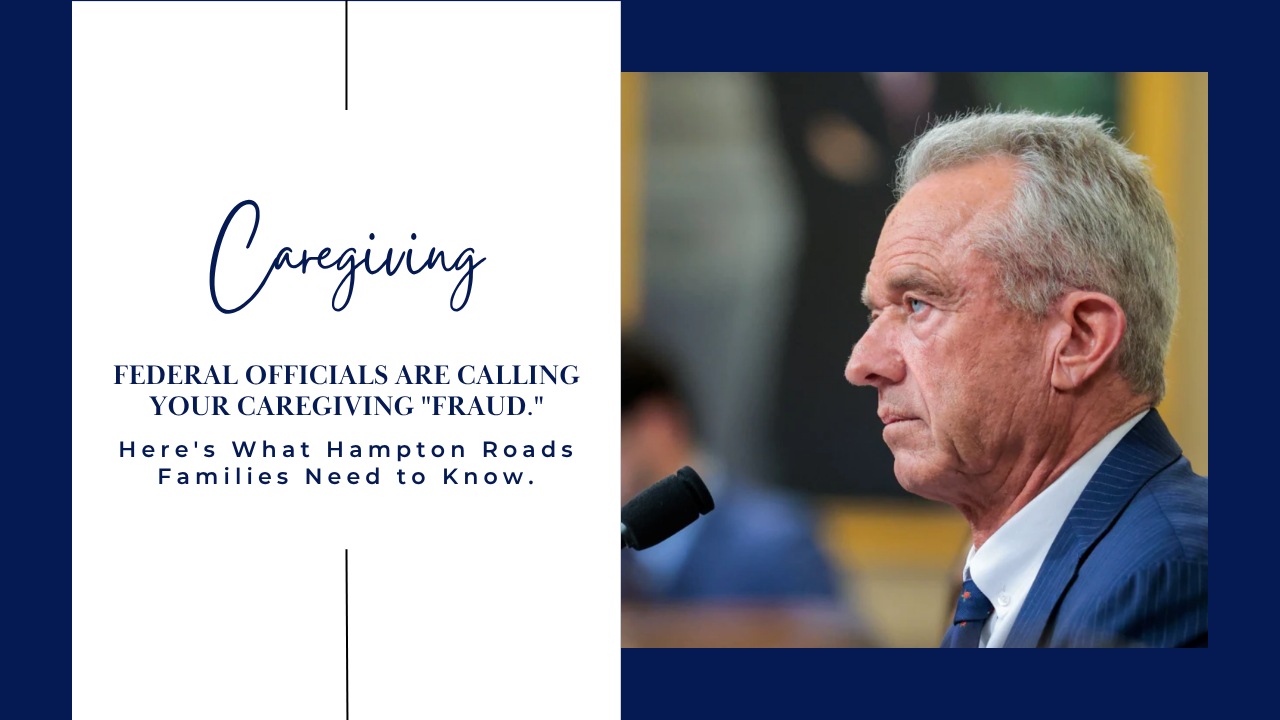
On April 16, 2026, U.S. Secretary of Health and Human Services Robert F. Kennedy Jr. testified before the House Ways and Means Committee.
During his testimony, he specifically targeted Medicaid programs that allow family members to be compensated for providing care to elderly or disabled relatives.
Kennedy described these programs as paying family members “for balancing the checkbook, for picking up the groceries, for driving somebody to a doctor’s appointment.”
He went on to say these are “things that they used to do as family members for free” and called the system “rife with fraud” because, according to him, there’s no way to verify whether caregivers actually perform these duties.
CMS Administrator Mehmet Oz made similar comments, describing personal care services as helping people do things “that our families would normally do for us, like carrying groceries,” in a recent social media video.
These aren’t offhand remarks.
These are the two officials in charge of overseeing the entire Medicaid program.
The same program that funds the home and community-based services (HCBS) your family may depend on.
Why This Matters to You
Here’s the thing: if your loved one receives services through Virginia’s DD Waivers – the Family and Individual Support (FIS) Waiver, Building Independence (BI) Waiver, or Community Living (CL) Waiver.
Or through the CCC Plus Waiver, the programs Kennedy and Oz are targeting are the same framework that makes your care possible.
Virginia’s consumer-directed service model allows individuals receiving waiver services to hire and manage their own caregivers, including family members.
As of 2020, relatives other than spouses or parents of minor children can be reimbursed for personal care and respite services under Virginia’s HCBS waivers.
During the pandemic, Virginia even expanded this to include spouses and parents of minors – and DMAS has received federal approval to extend some of those processes while policy changes are discussed in the General Assembly.
In other words, Virginia specifically designed its waiver programs to allow families to serve as paid caregivers.
It’s not a loophole. It’s the system working as intended.
And nationally?
Over 11 million Americans are compensated through government programs for caring for elderly or disabled family members.
Meanwhile, more than 600,000 people sit on waitlists for home and community-based services nationwide.
Not because of fraud, but because there aren’t enough caregivers to go around.
What Disability Advocates Are Saying
The backlash from the disability community has been swift and forceful.
Katy Neas, CEO of The Arc of the United States, issued a statement calling the comments a “troubling pattern of mischaracterizing Medicaid and the essential role of home and community-based services.”
She emphasized that for many families dealing with a severe shortage of direct care workers, a family member isn’t just a preferred caregiver, they’re the only reliable option.
Barbara Merrill, CEO of ANCOR (the American Network of Community Options and Resources), called the comments “deeply concerning” and said they demean “the very real, complex and difficult work that caregivers – whether paid or unpaid provide.”
Kim Musheno, Senior Director of Medicaid Policy at The Arc, was more direct, calling the remarks “insulting” to both families and the professionals who support people with disabilities.
And honestly? They’re right to be alarmed. These comments aren’t happening in a vacuum.
The Bigger Picture: $911 Billion in Medicaid Cuts
This rhetoric comes on top of the One Big Beautiful Bill Act, which Republicans pushed through Congress in 2025.
The law is projected to reduce federal Medicaid spending by approximately $911 billion over the next decade, according to Congressional Budget Office estimates analyzed by the Kaiser Family Foundation.
The cuts are expected to begin taking effect in late 2026.
And here’s what keeps disability advocates up at night.
Because HCBS are classified as “optional” under federal Medicaid rules, they’re among the first services states are likely to reduce when budgets tighten.
Multiple states – including Idaho, Missouri, Maryland, Colorado, Utah, and Washington – are already weighing proposals to cut funding for community-based disability services, citing financial pressure from the federal cuts.
As Disability Belongs™ reported, states are now preparing to implement work requirements, more frequent eligibility checks, and other changes that increase the risk of coverage loss.
Particularly for people who depend on HCBS to live in their communities rather than institutions.
Virginia, for its part, funded 1,720 new DD waiver slots in FY 2026, bringing total slots to 21,479.
But as of November 2025, 14,258 individuals remained on Virginia’s DD waiver waitlist – and with federal funding pressure mounting, the question is whether that progress holds.
What You Need to Know Right Now
Your current waiver services are not changing today.
No law has been passed to eliminate family caregiver reimbursement.
Kennedy’s comments were testimony, not legislation.
Virginia’s consumer-directed programs remain in effect.
But the ground is shifting. When the officials who oversee Medicaid publicly frame family caregiving as fraud, it creates political cover for future cuts.
Pay attention to what your state legislators and Virginia’s DMAS are saying in the coming months.
Document everything. If you’re a family caregiver receiving Medicaid reimbursement, keep thorough records of the care you provide.
Virginia already requires training, documentation, and oversight through its fiscal/employer agent system, but in a climate where programs are being scrutinized, your documentation is your protection.
Know your rights. Virginia’s consumer-directed option is not a gray area.
It’s a long-standing, federally approved program that has been recognized by the National Academy for State Health Policy as a model for other states.
You are not committing fraud by participating in it.
Make your voice heard. Contact your state legislators and congressional representatives.
Organizations like The Arc of Virginia and the National Disability Navigator Resource Collaborative are tracking these developments and providing tools for advocacy.
What We See at CDS
At Community Direct Services, we’ve worked alongside Hampton Roads families for over two decades.
We know what family caregiving actually looks like, and it’s not “picking up groceries.”
- It’s the parent who knows exactly how to calm their adult child during a sensory crisis at 2 AM.
- It’s the sibling who has memorized a medication schedule that would overwhelm a spreadsheet.
- It’s the spouse who has rebuilt their entire life around keeping their partner safe, healthy, and home.
That work has value. It deserves respect.
And it deserves to be compensated, not dismissed as fraud.
If you have questions about your waiver services, your rights as a consumer-directed employer, or how to navigate the changes ahead, we’re here.
Call us at (757) 965-4899, email us at info@cdsva.com, or visit us at communitydirectservices.com.
You’re not just a caregiver. You’re the reason your loved one gets to live at home, in their community, with dignity. Don’t let anyone tell you otherwise.
Sources & Resources
- Disability Scoop — RFK Jr. Takes Issue With Medicaid Paying Family Caregivers (April 23, 2026)
- NBC News — RFK Jr. Draws Backlash for Ripping Medicaid Programs That Pay People to Care for Relatives (April 2026)
- The Arc of the United States — Statement on Kennedy’s Medicaid and HCBS Comments (April 20, 2026)
- ANCOR — ANCOR Rebuts RFK Jr.’s Remarks on HCBS (April 2026)
- Disability Scoop — Nation’s Disability Services System Faces ‘Unprecedented’ Threats (March 30, 2026)
- Disability Scoop — Congress Approves Nearly $1 Trillion in Cuts to Medicaid (July 3, 2025)
- Kaiser Family Foundation — Allocating CBO’s Estimates of Federal Medicaid Spending Reductions Across the States (July 2025)
- Disability Belongs™ — Medicaid Changes States Are Rolling Out in 2026 (March 2, 2026)
- NASHP — Paying Family Caregivers through Medicaid Consumer-Directed Programs (April 2025)
- Virginia DMAS — Waivers
- Virginia DBHDS — Developmental Disability Waivers 2026 Report
- The Arc of Virginia — Medicaid Waivers