

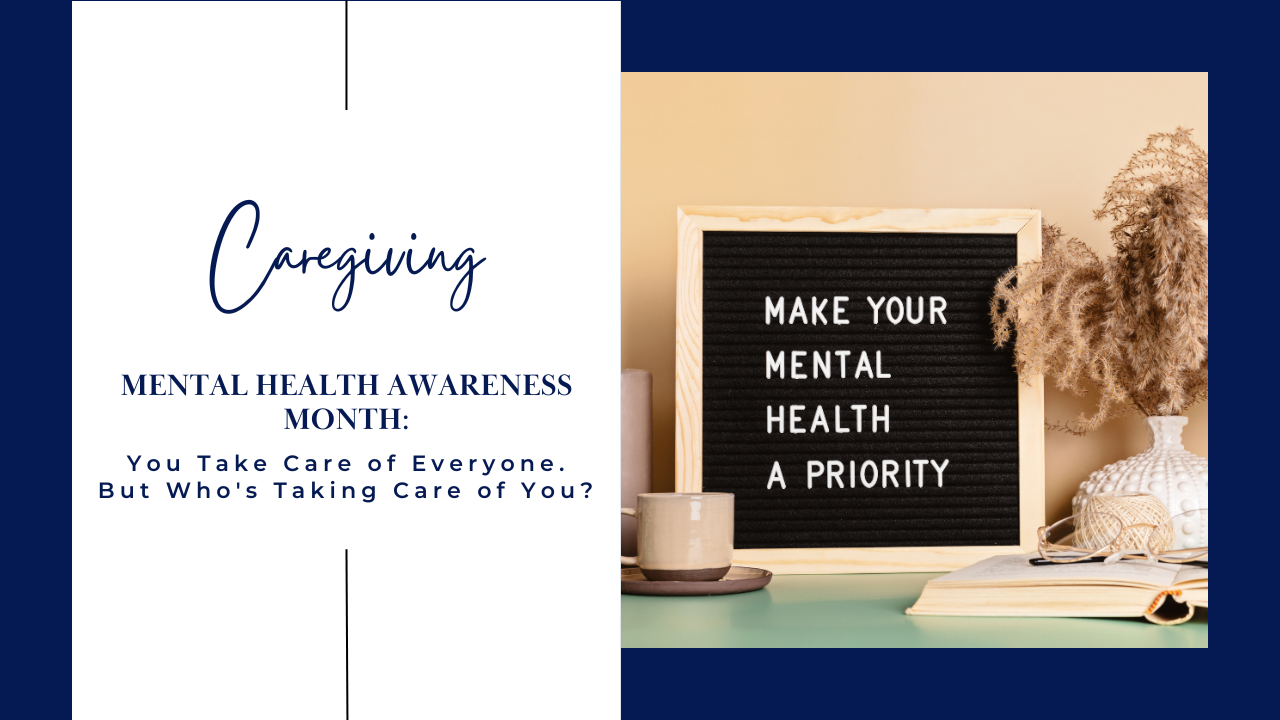
Mental Health Awareness Month: You Take Care of Everyone. But Who’s Taking Care of You?
Close your eyes for a moment.
Think about the last time someone asked how you were doing.
Not how your loved one’s appointment went, not whether the new medication is working, not how the transition at school is going.
Just you.
If you can’t remember, you’re not alone.
And that silence, the one where your own needs disappear into the daily work of keeping someone else safe, healthy, and connected – is exactly why this month matters.
May is Mental Health Awareness Month.
This year’s theme from Mental Health America is “More Good Days, Together.”
And if you’re a family caregiver, that word “together” probably hits different. Because most days, it feels like you’re doing this alone.
The Numbers Behind the Silence
Let’s be honest about what the research shows, because naming the problem is the first step toward solving it.
According to data published by the Centers for Disease Control and Prevention, caregivers experience lifetime depression at a rate of 25.6%, compared to 18.6% among non-caregivers.
That data comes from the CDC’s Behavioral Risk Factor Surveillance System, which analyzed responses from over 92,000 caregivers across 35 states.
But those are the numbers for all caregivers.
When you narrow the lens to parents caring for children or adult children with developmental and intellectual disabilities, the picture gets more intense.
Multiple studies have found that 40% to 70% of family caregivers in this population show clinically significant symptoms of depression, with many also reporting negative effects on their physical health, employment, and financial stability.
A recent study published in April 2026 in Aging & Mental Health found that approximately one in four American adults – roughly 59 million people – serve as caregivers to adult family members and friends with a disability or serious chronic health condition.
The study confirmed that changes in caregiver burden directly predicted changes in both depression and anxiety symptoms over time.
And here’s what doesn’t show up in any study: the guilt you feel for feeling this way.
The voice that says, “I shouldn’t complain — my child has it harder.”
The way you cancel your own doctor’s appointment because something came up with your loved one’s care.
The friendships that quietly dissolved because people stopped inviting you, or because you stopped having the energy to show up.
That’s not weakness.
That’s what happens when the system asks you to pour from an empty cup, and then tells you to smile about it.
Why Caregivers Don’t Ask for Help
If you’ve ever thought, “I should probably talk to someone,” and then immediately pushed that thought aside, you’re in good company.
Caregivers are notoriously reluctant to seek mental health support, and the reasons are deeply human.
Guilt. You feel like asking for help means you can’t handle it, and that feels like failing your loved one.
Research on caregiver burnout among mothers of children with special needs, published in Frontiers in Psychology, found that self-stigma is one of the strongest predictors of caregiver burnout.
The more shame a caregiver feels about needing help, the faster they burn out.
Time. When your day is structured around someone else’s needs – therapies, appointments, medication schedules, behavioral support – your own appointments get pushed to “someday.”
And someday never comes.
The belief that no one gets it. You’ve tried to explain your life to friends, to family, maybe even to a therapist.
And the well-meaning but misguided advice – “Have you tried this diet?” “All kids throw tantrums” – makes you retreat further.
It’s lonely to feel misunderstood by the people who are supposed to be your support system.
The identity shift. Somewhere along the way, “caregiver” became your whole identity. You used to have dreams, ambitions, hobbies.
Now your only goal is to get through the day. Acknowledging that loss – grieving the life you thought you’d have – feels like a luxury you can’t afford.

What “More Good Days” Actually Looks Like
Mental Health America’s 2026 theme asks a deceptively simple question:
What does a good day look like for you?
Not a perfect day. Not a day without challenges. Just a good one.
For caregivers, “good” might look smaller than the world expects, and that’s okay.
A good day might be:
- Your loved one trying something new and smiling about it.
- A phone call with someone who actually understands.
- Twenty minutes alone with a cup of coffee while it’s still hot.
- Getting through bedtime without a crisis.
- Feeling, for just a moment, like things might be okay.
The key insight behind this year’s theme is that good days aren’t random, they can be built.
Not through willpower or positive thinking, but through structures, supports, and small decisions that add up over time.
Five Things You Can Do This Month. Starting Today.
These aren’t grand gestures.
They’re small, realistic steps that research supports and that fit into a caregiver’s actual life.
1. Name what you’re feeling – out loud or on paper.
Neuroscience research shows that simply labeling an emotion – saying “I feel overwhelmed” or writing “I’m angry today” – activates the prefrontal cortex and reduces the intensity of the emotion.
Psychologists call this “affect labeling.” You don’t need a journal or an app. A sticky note on the fridge works.
2. Stop canceling your own appointments.
Your health is not optional. If your blood pressure, your sleep, or your mood has shifted, that deserves attention.
The 988 Suicide & Crisis Lifeline is available 24/7 by call or text for anyone who needs to talk – including caregivers who aren’t in crisis but are running on empty.
3. Connect with one person who gets it.
Not someone who will give advice. Someone who will say, “Me too.” NAMI’s Mental Health Awareness Month resources include tools for finding local support groups and sharing your story.
SAMHSA’s 2026 toolkit offers free, downloadable resources for starting conversations about mental health in your community.
4. Use respite care – and stop feeling guilty about it.
If your loved one is enrolled in one of Virginia’s DD Waivers, you have access to funded respite services – up to 480 hours per state fiscal year. That’s not a luxury.
It’s a service designed specifically so you can take a break without your loved one’s care being compromised. Consumer-directed respite lets you choose someone your loved one already knows and trusts.
If your family isn’t on a waiver, the ARCH National Respite Network maintains a national locator for respite and crisis care services, and Virginia’s Lifespan Respite Voucher Program may offer additional options.
5. Redefine what “strong” means.
Strength isn’t silence. It isn’t pushing through until you collapse. Strength is saying, “I need a hand.” It’s scheduling that therapy appointment.
It’s letting someone else handle bedtime so you can sit in your car and breathe for ten minutes.
The CDC’s data is clear: caregivers who access support have better health outcomes – not just emotionally, but physically.
Your resilience isn’t infinite. It needs to be replenished.
What We See at CDS
At Community Direct Services, we’ve been alongside Hampton Roads families for over two decades.
And one pattern we see over and over is this: the caregiver who calls us about their loved one’s services is the same person who hasn’t slept well in months.
Hasn’t seen a doctor in over a year, and hasn’t had an uninterrupted conversation with a friend in longer than they can remember.
We see you.
Our services – from personal assistance and respite care to behavioral consultation – are designed not just to support your loved one, but to give you room to breathe.
Because the quality of care your loved one receives is directly connected to your own wellbeing.
You are not selfish for needing support. You are not failing because you’re tired. You are doing one of the hardest jobs in the world, and you deserve to have good days too.
If you need to talk about your options – or if you just need someone to listen who actually understands – call us at (757) 965-4899, email info@cdsva.com, or visit communitydirectservices.com.
This Mental Health Awareness Month, take care of the caregiver. Take care of you.
Sources & Resources
- Mental Health America — Mental Health Month 2026: “More Good Days, Together”
- SAMHSA — 2026 Mental Health Awareness Month Toolkit
- NAMI — Mental Health Awareness Month
- CDC / BRFSS — Changes in Health Indicators Among Caregivers, 2015-2022
- Aging & Mental Health (2026) — Caregiver Burden: Changes Over Time and Associations with Anxiety and Depression
- Frontiers in Psychology (2025) — Caregiver Burnout Among Mothers of Children with Special Needs
- 988 Suicide & Crisis Lifeline — 988lifeline.org (call or text 988)
- CDS Blog — Respite Care Options for Virginia Families
- ARCH National Respite Network — archrespite.org
- Virginia DMAS — DD Waivers Information
- CDS Services Page — communitydirectservices.com/our-services/