

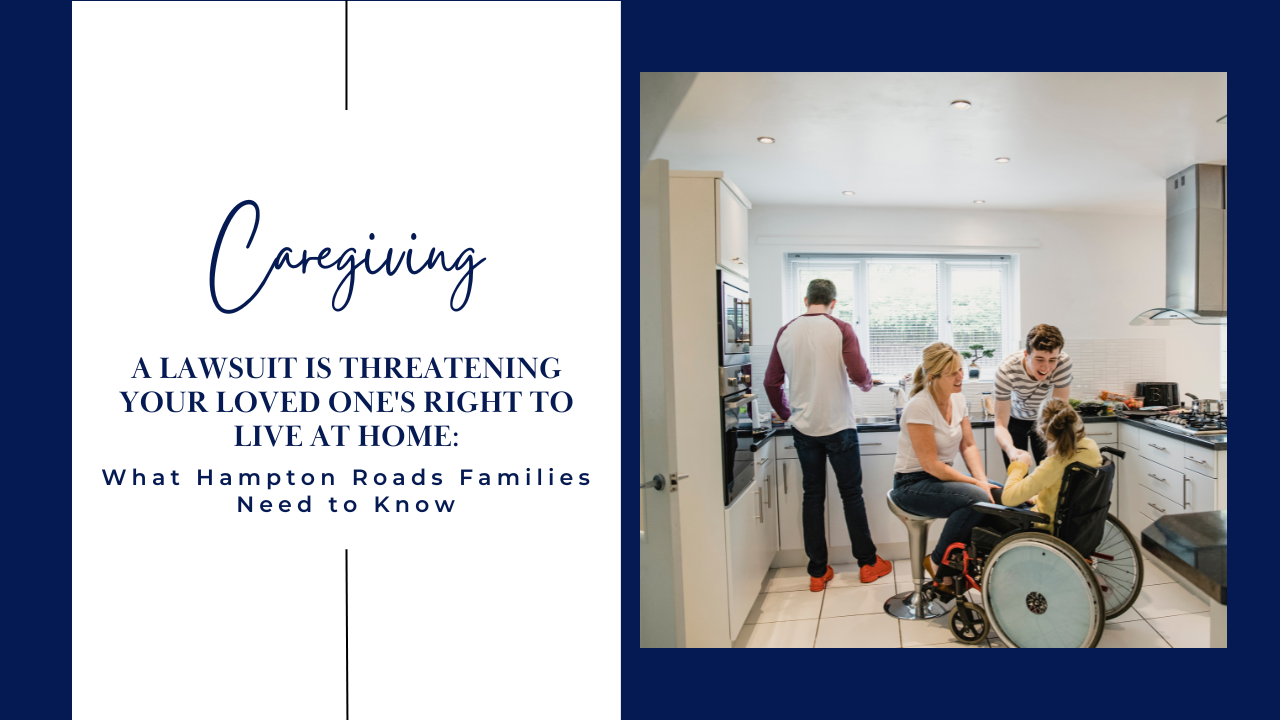
A Lawsuit Is Threatening Your Loved One’s Right to Live at Home: What Hampton Roads Families Need to Know
Close your eyes for a moment and picture your loved one. Maybe they’re on the couch watching their favorite show.
Maybe they’re in the kitchen, helping set the table.
Maybe they’re in a home they chose, in a neighborhood they love, surrounded by people who know their name.
Now imagine someone telling you that arrangement – the one you fought for, the one that works – might not be legally protected anymore.
That’s what’s at stake right now in a federal lawsuit called Texas v. Kennedy.
And if you have a family member receiving home and community-based services through a Virginia Medicaid waiver, you need to understand what’s happening.
What’s Going On
A group of states led by Texas – including Alaska, Florida, Kansas, Louisiana, Missouri, and Montana…
Are asking a federal court to block a 2024 HHS rule implementing Section 504 of the Rehabilitation Act.
Including protections that require services in the most integrated setting and prohibit policies that put people with disabilities at serious risk of institutionalization.
The lawsuit originally included nine states, but the roster has shifted as advocacy pressure has mounted.
The rule they’re targeting is one of the most foundational disability rights protections in the country.
Specifically, they’re going after what’s called the “integration mandate” – the principle that says states must serve people with disabilities in the most integrated setting appropriate, not warehouse them in facilities when community-based care would work.
DREDF maintains an up-to-date tracker on which states remain involved and what’s at stake.
This isn’t a hypothetical policy debate.
This is the legal foundation that makes it possible for your loved one to receive care at home instead of in an institution.
Why This Matters Now
This lawsuit has been moving through the courts since late 2024, but it hit a critical turning point in May 2026.
The good news: advocacy is working. According to court filings posted by DREDF, Indiana filed a notice of dismissal on May 1, and South Dakota followed on May 12.
That’s two states walking away because disability advocates, families, and organizations pushed hard enough to change their minds.
The concerning news: the remaining states are pushing for a summary judgment – asking the judge to rule in their favor without a full trial.
And disability advocacy organizations are preparing amicus briefs (legal arguments supporting the other side) as part of a briefing schedule that, according to DREDF, runs through the summer of 2026, with amicus filings expected in June.
This is happening right now, and the outcome could reshape disability services across the country.
The Olmstead Connection
To understand why this matters, you need to know about a Supreme Court decision called Olmstead v. L.C. from 1999.
In plain terms, Olmstead established that people with disabilities have the right to live in the community when appropriate – not be confined to institutions against their will or their family’s wishes.
Olmstead is a key legal reason your loved one can receive personal assistance, companion care, or sponsored residential services in a home setting instead of a facility.
Along with federal Medicaid authorities and Virginia’s own policy choices, it’s a major force behind why the state’s DD Waivers fund community-based care rather than defaulting to institutional care.
The Section 504 rule that these states want struck down essentially puts Olmstead‘s principles into enforceable federal regulation.
Without it, enforcement weakens. And when enforcement weakens, the rights it protects become harder to defend.
As Alison Barkoff, who led the federal Administration on Community Living under the previous administration, put it: this lawsuit threatens one of the most fundamental and hard-won rights of people with disabilities – the right to live and participate in their own communities.

What This Means for Virginia Families
Virginia is not one of the states in this lawsuit. That’s worth noting.
But here’s what many families don’t realize: if this lawsuit succeeds, the weakened legal framework affects every state, including Virginia.
The integration mandate isn’t just a policy on paper.
It’s the pressure point that keeps state Medicaid programs investing in home and community-based services (HCBS) rather than defaulting to cheaper institutional placements.
Remove that pressure, and the decades-long shift toward community living could start to reverse.
For Hampton Roads families, this connects directly to the challenges we talked about in our post on Medicaid changes earlier this year.
With significant Medicaid cost-cutting measures working through Congress and ongoing pressure to reduce spending over the coming decade, advocates have been warning that optional services like HCBS are the most vulnerable.
A court ruling that weakens the legal requirement to provide community-based care would make those services even easier to cut.
Your loved one’s waiver slot. Your respite care. Your personal assistance services.
They all exist within a system that is much easier to defend when strong federal integration protections are in place.
What You Can Do Right Now
You might be reading this and thinking, This is happening in a Texas courtroom – what can I do from Virginia Beach?
More than you think.
Stay informed. The Disability Rights Education & Defense Fund (DREDF) has a detailed action page with updates, plain-language explanations, and contact information for the attorneys general involved. Bookmark it.
Share this with other families. Most caregivers don’t know this lawsuit exists. If you’re in a support group, a Facebook group, or connected to other families through your CSB, share this information. Awareness is the first step to action.
Contact your Virginia representatives. While Virginia isn’t a plaintiff in this case, your federal legislators can speak out in support of community living protections. Let them know this matters to your family.
Support advocacy organizations. Groups like The Arc, DREDF, and the disAbility Law Center of Virginia are actively fighting to protect these rights. They’re preparing amicus briefs this summer as part of the court’s briefing schedule. Your voice and your story strengthen their case.
Document the impact of community-based services. If you’ve ever been asked to write about how HCBS has changed your family’s life, now is the time. Real stories from real families are powerful evidence. The Senate Aging Committee has invited families to share their experiences via email.
Where CDS Stands
At Community Direct Services, we’ve spent nearly 20 years providing personal assistance, companion care, respite, and sponsored residential services to families across Hampton Roads.
Every one of those services exists because of the community living model that this lawsuit threatens.
We see what community-based care does every day. We see the independence it builds. We see the dignity it preserves. We see the families it holds together.
We’re watching this case closely, and we’ll continue to keep you informed as it develops. Because this isn’t someone else’s fight. It’s ours — all of ours.
If you have questions about how this might affect your family’s services, or if you just need someone to talk it through with, we’re here.
Call us: (757) 965-4899 Email: info@cdsva.com Visit: communitydirectservices.com
Sources & Resources
- Disability Scoop — States Ask Federal Court To Strike Disability Protections (May 19, 2026): disabilityscoop.com
- DREDF — Texas v. Kennedy: What It Is and How You Can Help Stop the Attack on Section 504 (Updated May 12, 2026): dredf.org/protect-504
- Disability Belongs — States Continue Legal Attack on Section 504 and the Right to Live in the Community (April 2026): disabilitybelongs.org
- CHCS — The Olmstead Decision 25 Years Later: chcs.org
- CDS Blog — Medicaid Is Changing Again: 4 Things Every Virginia Disability Family Should Do Before December: communitydirectservices.com
- CDS Services — Our full range of community-based care services: communitydirectservices.com/our-services
- disAbility Law Center of Virginia — Virginia’s Protection & Advocacy organization: dlcv.org