
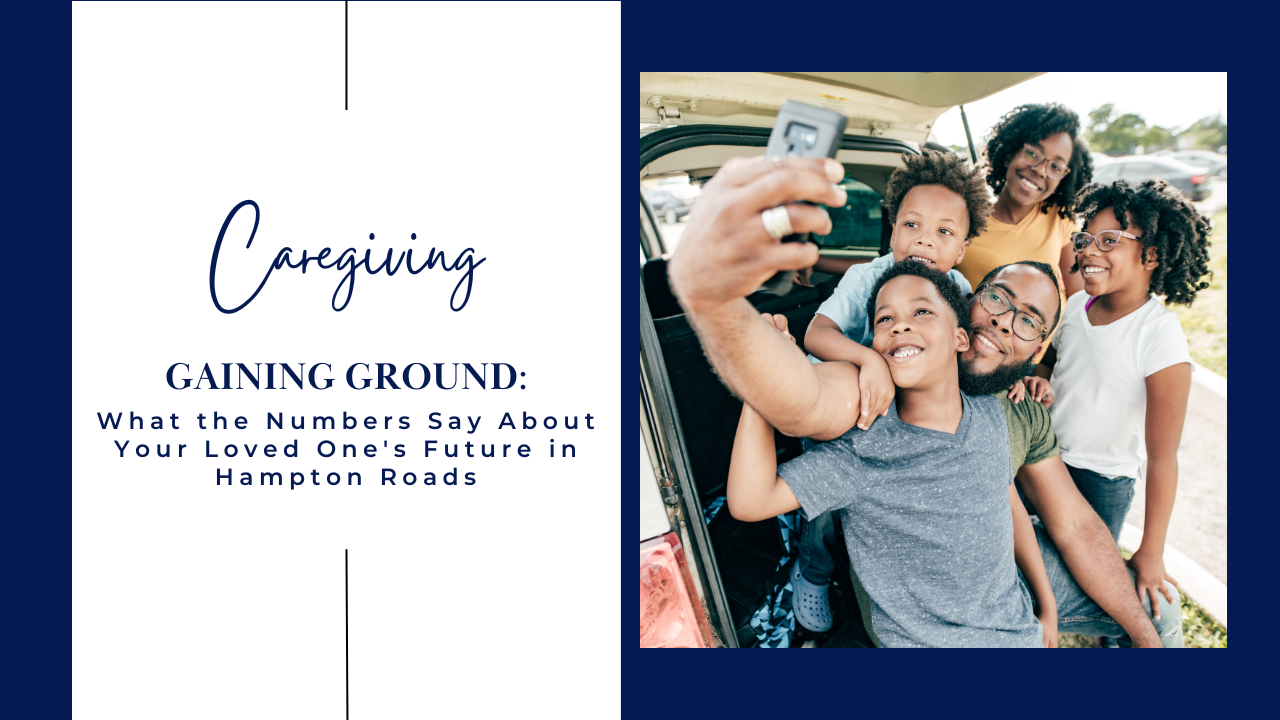
Gaining Ground: What the Numbers Say About Your Loved One’s Future in Hampton Roads
You’ve lain awake with the question. Most parents in your position have.
What happens to my child when I’m not the one holding it all together?
It’s the fear underneath the paperwork, the appointments, the fights with insurance.
Not just “will they be okay today,” but “will there be a place for them in the world.”
So here’s something we don’t want you to miss, because it rarely makes the headlines the way the scary news does.
In our own backyard, the answer to that question is slowly, measurably getting better.
What the Region Just Learned About Its Own Workforce
The Hampton Roads Planning District Commission, the regional body that studies our local economy, recently published a report with a title we love: Gaining Ground: Disabled Workers in Hampton Roads.
The picture it paints is genuinely hopeful.
In Hampton Roads, approximately 235,000 residents live with a disability, and more of them are working than at almost any point in the last decade.
The report found that labor force participation among disabled workers has risen considerably over the past ten years, with the pace picking up sharply after the pandemic.
The national trend backs this up: the disabled labor force participation rate climbed from 43.4% in 2019 to 51.7% by 2024, a jump of more than eight percentage points in just four years, after decades of barely moving.
One likely reason: the rapid spread of remote and flexible work lowered barriers that used to lock capable people out.
We’ve watched this shift happen in real time, in real living rooms, across Virginia Beach, Norfolk, Chesapeake, and Newport News.

Why Hampton Roads Is a Little Different, In a Good Way
Our region has a feature most places don’t, and it works in your loved one’s favor.
Because of our deep military and federal presence, federal government workers make up 12.1% of employed disabled workers here, nearly three and a half times the national share of 3.5%.
Federal employers tend to have established accommodation processes, structured roles, and a stronger track record of hiring people with disabilities than the average private employer.
The report also surfaced something practical that we talk about with families all the time: getting to work.
They’re more likely to carpool, use public transit, walk, or work from home.
That’s not a limitation. That’s a roadmap.
It tells you that employment and independence in this region don’t require a driver’s license.
They require the right supports around transportation, routine, and confidence.
Let’s Be Honest About the Other Half
We’re not going to hand you a rosy story and pretend the gap is closed.
It isn’t.
The same report is clear that a substantial share of the region’s disabled population remains outside the workforce entirely.
Nationally, only 22.8% of people with a disability were employed in 2025, according to the U.S. Bureau of Labor Statistics, still far below the rate for people without a disability.
Progress and struggle live side by side.
You already know that better than any statistic could tell you.
But here’s the thing about a trend line that’s pointing up: your loved one is not walking into a closing door.
They’re walking into a region that is, year over year, getting better at making room for them.
And what happens between now and the day they step into that room is largely about the foundation you build starting today.
What You Can Actually Do With This
Momentum in a spreadsheet doesn’t help your family unless it turns into steps.
Here’s where we’d start.
- Think “employability” early, not at 21. The skills that lead to a job (following a routine, communicating a need, managing a task start to finish) are the same skills that lead to independence. They’re built over years, through everyday practice, not in a single transition meeting.
- Treat transportation as a skill to teach, not a barrier to fear. Given what the regional data shows, comfort with a bus route, a carpool, or a predictable travel routine may matter as much as any job-specific training. This is exactly the kind of real-world, community-based skill-building we work on.
- Connect with your local Community Services Board (CSB). Your CSB is the front door to Virginia’s Developmental Disability (DD) Waivers, the Medicaid programs that fund supported employment, community engagement, and the day-to-day help that makes work possible. A DD Waiver (a Medicaid program that pays for home- and community-based support) can be the bridge between potential and a paycheck.
- Explore Virginia’s employment supports. The Commonwealth’s Department for Aging and Rehabilitative Services (DARS) offers vocational rehabilitation services designed to help Virginians with disabilities prepare for, find, and keep work.
- Celebrate small wins as workforce wins. Every time your loved one completes a chore, waits their turn, or handles a change in plans without a crisis, that’s not just a good day. That’s a résumé being built one moment at a time.
Where We Come In
At Community Direct Services, we’ve spent almost 20 years walking Hampton Roads families toward exactly the future this report describes.
We see the person first, not the diagnosis, and we’ve never met a person without talents worth building on.
That’s the heart of how we work. Two of our five guiding principles are Self-Direction, promoting informed choice and control, and Talents and Gifts, creating opportunities for people to share their abilities.
Our Personal Assistance and Supportive In-Home services are built to strengthen the everyday skills (routine, communication, community access) that this data shows are the real on-ramps to independence and, eventually, work.
We can’t promise you your child’s future. Nobody honest can.
But we can tell you that the ground really is shifting in our region, and that the work you do now, the patient, unglamorous, everyday work, is what lets them stand on it.
You’re not just getting through today.
You’re building someone’s tomorrow.
And here in Hampton Roads, tomorrow is looking more possible than it did a decade ago.
If you want help building that foundation, whether it’s skill-building, navigating the DD Waiver, or just talking through where to start, we’re here.
Community Direct Services, Inc. 📞 (757) 965-4899 📧 info@cdsva.com 🌐 communitydirectservices.com 📍 5705 Thurston Ave., Virginia Beach, VA 23455 🕐 Monday–Friday, 9:30am–4:30pm
Sources & Resources
- Gaining Ground: Disabled Workers in Hampton Roads. Hampton Roads Planning District Commission (HRPDC) Economic Monthly: https://hrpdcva.gov/CivicAlerts.aspx?AID=311&ARC=727
- People with a Disability: Labor Force Characteristics, 2025. U.S. Bureau of Labor Statistics: https://www.bls.gov/news.release/archives/disabl_03032026.pdf
- Developmental Disability (DD) Waivers. Virginia Department of Medical Assistance Services (DMAS): https://www.dmas.virginia.gov/for-members/benefits-and-services/waivers/developmental-disability-dd-waivers/
- Vocational Rehabilitation. Virginia Department for Aging and Rehabilitative Services (DARS): https://www.vadars.org/
- Community Direct Services, Our Services: https://communitydirectservices.com/our-services/