

Virginia Just Drew a Line in the Sand: What “Keep Virginia Covered” Means for Your Family
If you’ve been feeling a low hum of anxiety every time the words “Medicaid cuts” scroll across your screen, you’re not imagining things.
The headlines have been relentless.
A trillion dollars in cuts. Work requirements. Hospitals closing.
And for families like yours, families who depend on home and community-based care to keep your loved one safe and thriving, every one of those headlines lands a little differently.
It’s not abstract policy.
It’s the person you love, and whether the support they need will still be there next year.
So let’s take a breath together, and talk about what actually happened last week.
Because for once, the news out of Richmond is worth reading.
What Happened
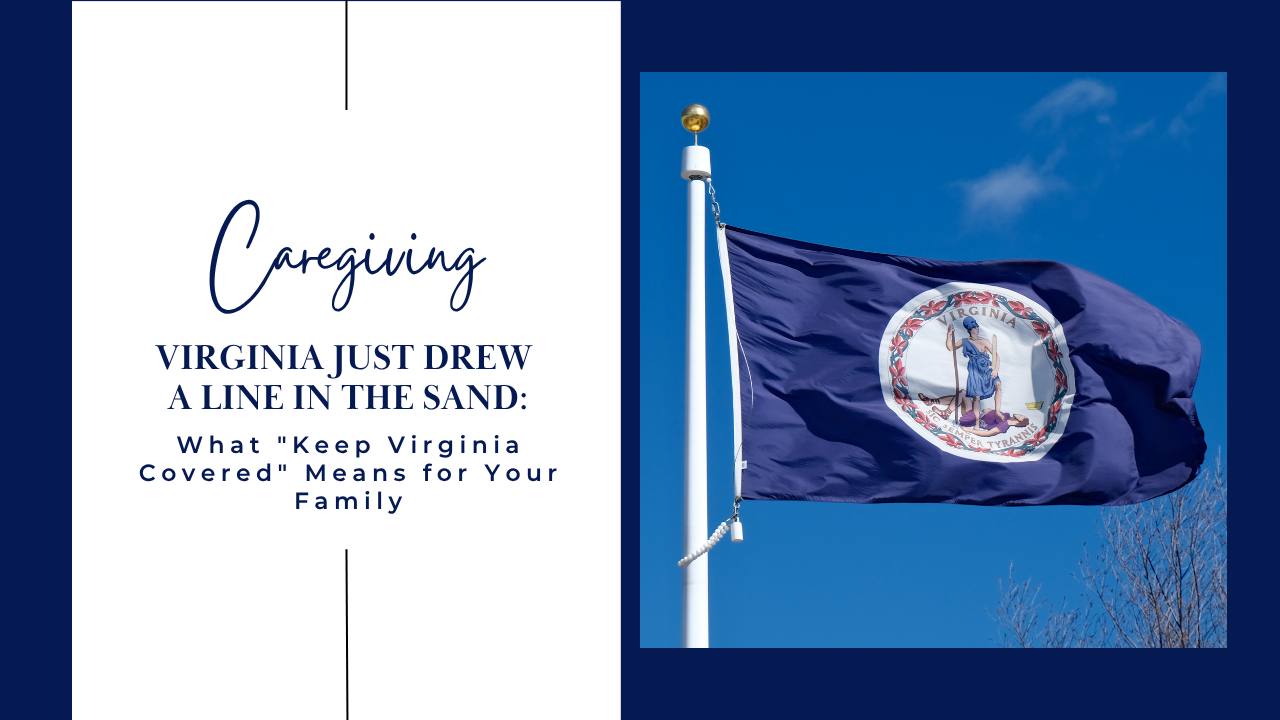
On August 25, 2026, Governor Abigail Spanberger signed Executive Order 20, establishing a policy she’s calling “Keep Virginia Covered.”
Its purpose is straightforward: to protect health coverage and food assistance for as many eligible Virginians as possible as the federal changes from H.R. 1, the law you’ve seen called the “One Big Beautiful Bill,” begin to take effect.
Here’s the scale of what’s at stake. More than 1.8 million Virginians are enrolled in Medicaid, and nearly 800,000 receive SNAP food benefits.
The Governor’s office projects that H.R. 1 threatens healthcare access for more than 300,000 Virginians and will cost the Commonwealth an estimated $1.8 to $2.6 billion in lost federal funds each year beginning in 2028.
Those are big, frightening numbers.
But the Executive Order is the state saying, plainly: we’re going to do everything within our power to keep eligible people covered.
What the Order Actually Does
An Executive Order isn’t a magic wand, and the Governor was honest about that.
She acknowledged the Commonwealth won’t be able to fill the entire gap left by federal cuts.
But the “Keep Virginia Covered” policy sets clear goals for how state agencies will respond.
In plain terms, it directs them to:
- Keep every Virginian who’s still eligible enrolled and covered.
- Reduce the paperwork and procedural hurdles wherever federal law gives Virginia room to do so.
- Connect people to workforce, employment, and economic-mobility resources.
- Find alternative paths to coverage where they exist.
- Build partnerships with private and community organizations to help fill gaps the state can’t cover alone.
Read that second goal again, because it’s the one that matters most for your family: reducing paperwork and procedural barriers.
Secretary of Health and Human Resources Marvin Figueroa put it bluntly.
The state’s job is to “cut down on paperwork and confusion where we can and help people who still qualify keep food on the table and keep getting the health care they need.”
That’s the crux of it. For most families we work with here in Hampton Roads, the danger isn’t that your loved one will suddenly become ineligible.
The danger is that eligible people fall through the cracks over a missed form, an outdated address, or a renewal notice that got buried in the mail.

What This Means for Your Loved One Specifically
Let’s separate real risk from headline noise.
First, the new work requirements apply only to certain adults in Medicaid Expansion, not to everyone with Medicaid.
And the exemptions matter enormously for our families. According to Virginia Medicaid (DMAS), the requirement doesn’t apply if you are “a parent, guardian, caretaker relative or family caregiver of a dependent child under age 14 or a person with a disability.”
Read that again: being the family caregiver of a person with a disability is itself an exemption.
People who receive SSI or SSDI are generally exempt as well, as a fact sheet from The Arc confirms.
That said, here’s the hard truth we won’t tiptoe around: the exemptions don’t run on autopilot.
Someone still has to document that you or your loved one qualifies.
The changes take effect January 1, 2027, when Medicaid Expansion coverage will also be reviewed every six months instead of every twelve, meaning more frequent paperwork, and more chances for an eligible person to slip through the cracks. Statewide, more than 500,000 Virginians will feel these changes.
So the question isn’t usually “Is my loved one still eligible?”
It’s “Will the paperwork prove it in time?”
That’s a very different, and far more manageable, problem.
What You Can Do Right Now
You don’t need to wait until January.
A few simple steps now will protect your family from the most common way people lose coverage they’re entitled to:
- Make sure your contact information is current with the Department of Medical Assistance Services (DMAS). If a renewal notice goes to an old address, you may never see it.
- Open every piece of mail from DMAS or your local Department of Social Services, even the envelopes that look like junk. Renewal and verification requests come with deadlines.
- Keep your loved one’s disability documentation somewhere you can find it: diagnosis letters, SSI/SSDI award letters, evaluations. If you’re ever asked to prove an exemption, you’ll want it ready.
- Check the state’s new locality dashboards. Virginia recently launched dashboards showing how the federal changes are projected to affect programs in your specific area, including the new work requirements.
- Don’t try to interpret it all alone. The rules are genuinely complicated, and they’re still settling.
That last point is where we come in.
How We Help
For almost 20 years, we’ve walked Hampton Roads families through exactly this kind of moment: the moment when the system changes the rules and no one hands you a clear explanation of what it means for your loved one.
Navigating the Medicaid and CCC Plus process is part of what our Support Coordinators do every single day.
If you’re reading this with a knot in your stomach, wondering whether any of it applies to your family, that’s a conversation worth having before the January deadline, not after.
We can help you understand where your loved one stands, make sure the right documentation is in place, and cut through the confusion so a paperwork problem never becomes a coverage problem.
At CDS, we see the person first, not the policy.
And right now, seeing the person first means making sure the person you love doesn’t get lost in the shuffle.
One honest note as you read all of this: policy is still moving.
Executive Orders can be amended, and the finer details of the federal exemptions are still being worked out.
What we’ve shared here is accurate as of early September 2026, and it’s exactly the kind of thing we keep watching so you don’t have to.
You’ve carried enough alone. Let us carry this part with you.
Call us anytime at (757) 965-4899, email info@cdsva.com, or visit us at communitydirectservices.com.
We’re here Monday through Friday, and we’re always glad to talk it through.
Sources & Resources
- Governor of Virginia, Executive Order 20 press release (Aug. 25, 2026): Governor Spanberger Signs Executive Order to Protect Virginians’ Healthcare & Food Assistance
- WHRO, reporting on the order and January 2027 eligibility changes: Spanberger orders state agencies to prepare for Medicaid, SNAP changes
- The Arc, fact sheet on federal Medicaid work requirements and disability exemptions: Update on Federal Medicaid Work Requirements
- Virginia Department of Medical Assistance Services (DMAS): dmas.virginia.gov
- Community Direct Services, Our Services: communitydirectservices.com/our-services