

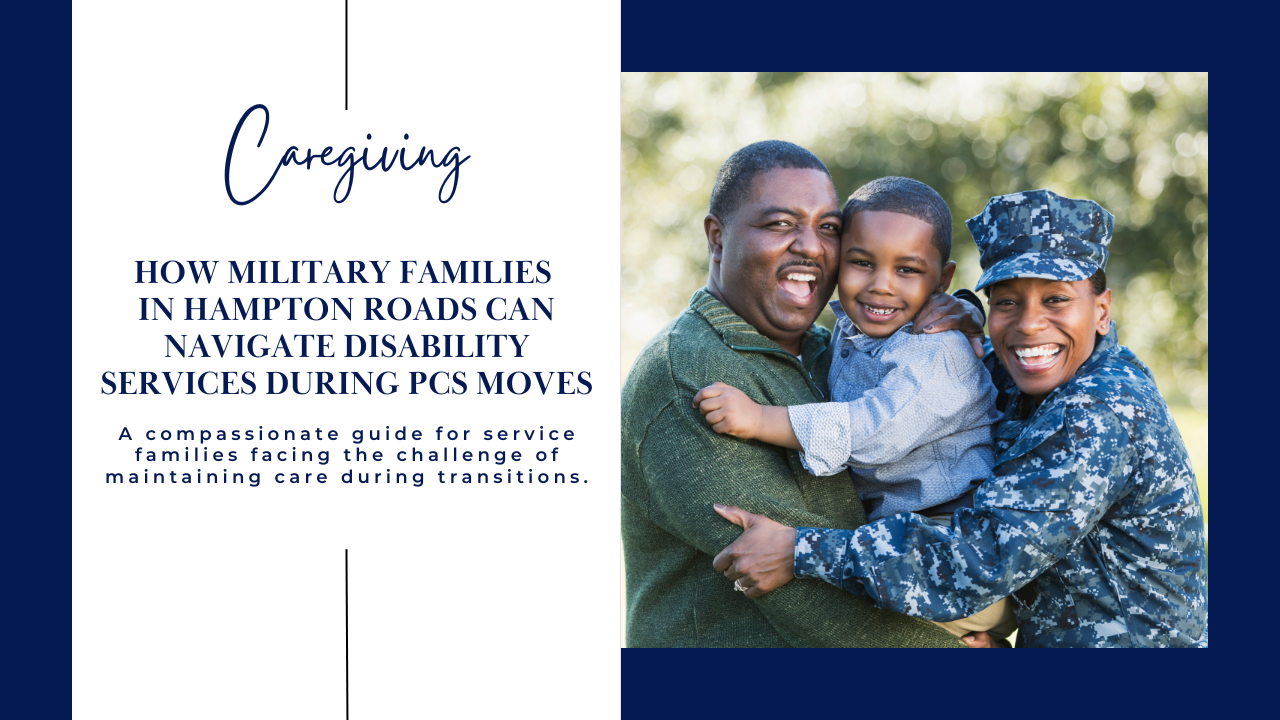
How Military Families in Hampton Roads Can Navigate Disability Services During PCS Moves
If you’re reading this, chances are you’re facing one of the most stressful situations a military family can encounter: managing a PCS move when your child or loved one receives disability services.
As someone who has walked alongside countless Hampton Roads military families through these transitions, we want you to know something important right from the start.
This is hard, and it’s okay to feel overwhelmed.
Here in Hampton Roads, we’re home to roughly 20% of the nation’s active military families, with Naval Station Norfolk alone employing nearly 58,000 military members.
That means we’ve seen just about every kind of PCS challenge you can imagine, and we’ve learned what works, what doesn’t, and how to make these transitions as smooth as possible for families like yours.
Understanding the Unique Challenge
Military families face obstacles that civilian families simply don’t encounter when it comes to disability services.
You’re not just changing addresses. You’re potentially changing states, time zones, and entire support systems.
Add in deployment schedules, housing allowance changes, and the pressure of military life, and it’s no wonder that maintaining consistent disability services feels overwhelming.
Here’s what makes your situation unique:
- Tight timelines: Military moves happen on military schedules, not disability services schedules
- Cross-state coordination: Services that work in Virginia might not exist in your new duty station
- TRICARE complexity: Coordinating military healthcare with civilian disability services requires expertise
- Deployment concerns: Planning for care when the primary caregiver deploys
The good news?
With the right planning and support, you can maintain quality care for your loved one throughout these transitions. Let’s break down exactly how to make that happen.
The 90-Day-Out Planning Timeline
Three months before your PCS: This is when the real work begins, and we know it feels early when you’re juggling everything else about moving.
But trust us, starting early makes all the difference.
Contact your current providers immediately.
Let them know your timeline and ask for:
- Copies of all current assessments and service plans
- Documentation of your loved one’s progress and goals
- Letters of medical necessity for continued services
- Contact information for similar providers at your new duty station
Reach out to your new installation’s Exceptional Family Member Program (EFMP) coordinator.
They’re your liaison for disability services at your new base and can provide crucial information about:
- Local disability service providers who work with military families
- State-specific waiver programs and eligibility requirements
- Timeline for service applications in your new state
- Emergency contacts for immediate needs upon arrival
Document everything.
Create a comprehensive file that includes:
- Current Individualized Education Program (IEP) or 504 Plan
- Medical records and diagnoses
- Current service authorizations
- Emergency contact information
- Daily routines and behavioral strategies that work
The 60-Day-Out Action Phase
Two months before your move: This is when you shift from planning to action.
Submit applications in your new state.
Don’t wait until you arrive. Many states allow you to begin the application process before you relocate.
Each state has different waiver programs, and what’s called “DD waiver services” in Virginia might be “Community Supports” or “Home and Community-Based Services” elsewhere.
Important Note: Many Medicaid waiver programs are state-specific and may not transfer directly. There is an increased risk of service gaps after a move, especially when switching states. Before relocating, contact your new state’s Medicaid office or disability services agency to verify the exact rules – eligibility, application timing, and any options for “portability” or transition support. If possible, advocate for expedited review or transitional services to minimize any gaps in care.
Coordinate with your new school district.
If your loved one receives educational services:
- Contact the special education department at your new base or in your new community
- Schedule an IEP transfer meeting for as soon as possible after arrival
- Ask about interim services if there’s a gap between your arrival and the formal IEP transfer
Plan for the transition period.
There will likely be a gap between ending services in Hampton Roads and beginning services at your new location. Prepare for this by:
- Identifying respite care options for the first few weeks
- Researching emergency services at your new location
- Preparing a “survival kit” of activities and strategies for unsupported days
Be Aware: Many states have long waiting lists for certain Medicaid waiver programs. It’s not uncommon for families to wait weeks, months, or even longer before new services can start. If your loved one relies on these supports, plan for the possibility of temporary gaps. Inquire about your new state’s waiting list and ask if military families receive priority or any form of expedited processing. Keep thorough records, documenting continuous need and prior eligibility can sometimes help your case.
Managing TRICARE and Civilian Services
One of the most complex aspects of military PCS moves is coordinating TRICARE benefits with civilian disability services.
Here’s what you need to know:
TRICARE covers medical necessities, but many daily living supports and community-based services are provided through state waiver programs. You’ll need both systems working together.
Request a TRICARE representative meeting at your new base within your first week.
Bring all documentation of your loved one’s current services and ask specifically about:
- Autism Care Demonstration (ACD) programs if applicable
- Extended Care Health Option (ECHO) benefits
- Local TRICARE-approved providers who specialize in your loved one’s needs
Understand state differences.
Virginia’s DD waiver might provide services that aren’t available in your new state, or vice versa.
Your EFMP coordinator can help you understand what’s available and how to access it.
Special Considerations for Deployment
If you’re facing a deployment either before or after your PCS, additional planning is crucial.
Before deployment: Ensure that the remaining parent has:
- Full legal authority to make medical and educational decisions
- All contact information for current providers and emergency services
- A detailed care plan that includes daily routines and crisis management
- Respite care arrangements for the additional stress of single parenting
After arrival at your new duty station: If deployment is coming up, prioritize:
- Establishing relationships with local providers quickly
- Creating a support network of other military families
- Identifying local emergency services and crisis intervention options
- Ensuring the remaining parent knows local resources and contacts

Hampton Roads Resources to Take With You
As you prepare to leave Hampton Roads, remember that you’ve been part of a community with exceptional resources for military families with special needs.
While you’ll be building new connections, these local resources can provide valuable documentation and referrals:
Children’s Hospital of The King’s Daughters (CHKD) has specialists who regularly work with military families and can provide referrals to similar specialists at your new location.
The Military Child Education Coalition offers resources specifically for special needs military children, including transition guides and advocacy support.
Local EFMP coordinators at Norfolk Naval Base, Joint Base Langley-Eustis, and other Hampton Roads installations have extensive networks and can connect you with coordinators at your new base before you arrive.
Making the Emotional Transition
Let’s be honest, this isn’t just about paperwork and phone calls.
You’re leaving a place where people know your loved one’s name, understand their needs, and have become part of your extended family.
That loss is real, and it’s okay to grieve it.
Prepare your loved one for the change.
Depending on their understanding level:
- Use social stories or visual schedules to explain the move
- Take photos of favorite places and people to bring with you
- Practice new routines before you leave
- Plan for maintaining some familiar items and schedules during the transition
Take care of yourself too.
Military spouses caring for individuals with disabilities face unique stressors. Remember…
- It’s normal to feel anxious about finding new providers
- You don’t have to have everything figured out before you move
- Other military families at your new location have walked this path and can offer support
- Your advocacy skills travel with you. You know your loved one best, regardless of location
The First 30 Days at Your New Duty Station
Week 1: Focus on immediate needs
- Register with TRICARE in your new area
- Contact your pre-arranged service providers
- Register with the local EFMP office
- Schedule school meetings if applicable
Week 2-3: Begin building your new support network
- Attend EFMP family events to meet other families
- Join local special needs support groups
- Explore community resources and recreational opportunities
- Schedule initial assessments with new providers
Week 4: Evaluate and adjust
- Assess how the transition is going for your loved one
- Identify any gaps in services that need to be addressed
- Connect with local advocacy organizations if needed
- Start building relationships with new providers and school staff
When Things Don’t Go According to Plan
Despite your best planning, sometimes things go wrong. Maybe your new state’s waiver program has a long waiting list. Perhaps the school district doesn’t have the specialized programs your child needs. Or maybe your loved one is struggling with the transition more than expected.
This doesn’t mean you’ve failed. It means you need to advocate, and you have the skills to do it.
- Document any service gaps or delays
- Contact your EFMP coordinator for additional support
- Reach out to local disability advocacy organizations
- Consider temporary private services while waiting for public programs
- Remember that transitions take time. Give yourself and your loved one grace
You’re Not Alone in This Journey
Here’s something we want every military family to know.
Your service to our country doesn’t go unnoticed, and neither do the extra challenges you face in caring for a loved one with disabilities.
Communities like Hampton Roads understand the sacrifices military families make, and many communities across the country share that appreciation.
As you prepare for your move, remember that you’re taking with you:
- The advocacy skills you’ve developed
- The knowledge of what your loved one needs to thrive
- The resilience that comes from navigating military life
- The love and commitment that drives everything you do
At Community Direct Services, we’ve been honored to serve military families for 20 years.
We’ve seen families successfully navigate PCS moves to Hawaii, Germany, Alaska, and everywhere in between.
While every move is challenging, every move is also possible with the right support and planning.
Your Next Steps
If you’re facing a PCS move in the coming months:
- Start planning now, even if it feels early
- Connect with your new EFMP coordinator as soon as you have orders
- Document everything about your loved one’s current services and needs
- Build in extra time for everything – nothing happens as quickly as you hope
- Be patient with yourself and your loved one during the transition
Remember, thousands of military families successfully navigate these moves every year.
With planning, advocacy, and patience, your family can too.
Helpful Resources:
- Military Child Education Coalition: https://www.militarychild.org
- TRICARE Autism Care Demonstration: https://www.tricare.mil/autism
- Navy Family Life Program: Available at all naval installations
- Social Security Administration guide for military families: https://www.ssa.gov/people/military/
Sources:
- Naval Station Norfolk Welcome Center data on military population
- Military Family Life Project, Hampton Roads demographics
- TRICARE policy guidance for special needs military families
- Exceptional Family Member Program coordination guidelines
Community Direct Services is proud to serve the military families of Hampton Roads. While we’ll miss working with you, our thoughts and support travel with you wherever the military takes your family. For current families preparing for PCS moves, call us at (757) 965-4899. We’re here to help make your transition as smooth as possible.