

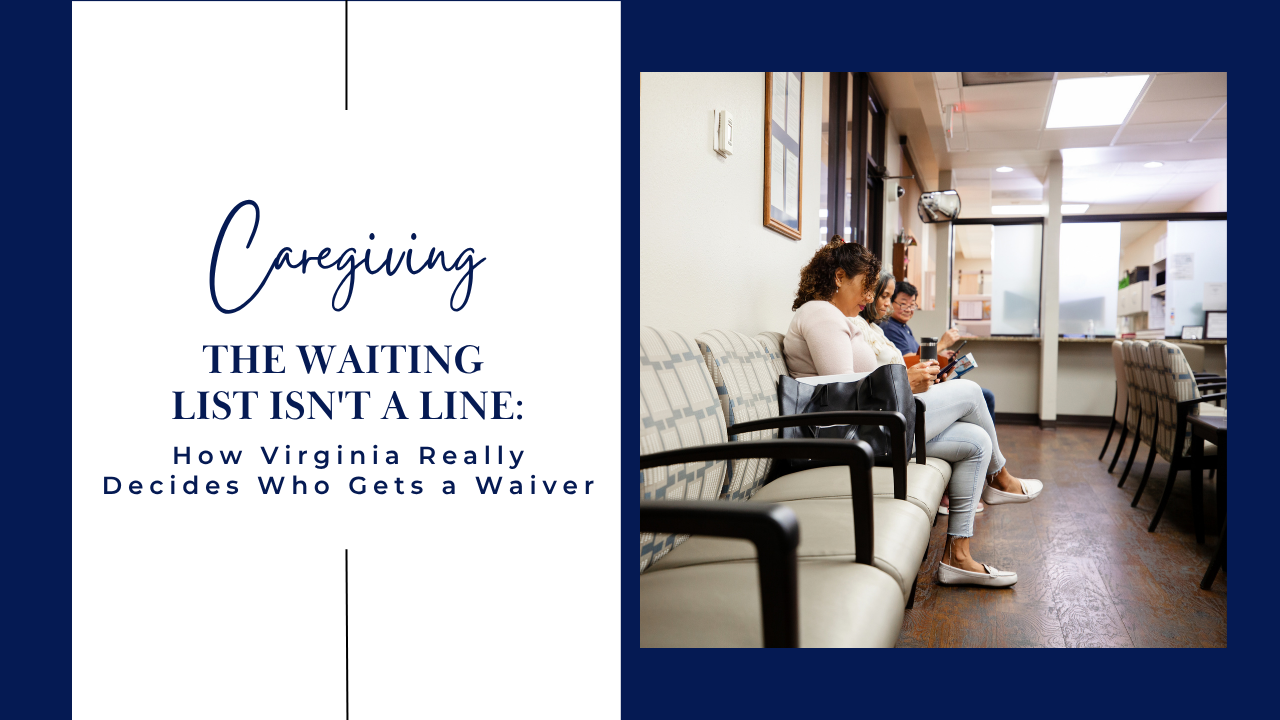
The Waiting List Isn’t a Line: How Virginia Really Decides Who Gets a Waiver
Picture the moment you finally got your loved one onto the DD Waiver waiting list.
Maybe you felt relief. Maybe you thought, okay, we’re in the queue now, we just have to wait our turn.
And maybe, ever since, you’ve been quietly counting: wondering what number you are, watching for movement, feeling that sinking sense that the line never seems to get shorter.
Here’s something that might change how you feel about the whole thing: there is no line.
Not the way you’re imagining it, anyway. And if that comes as a surprise, you are in very good company.
The Commonwealth of Virginia itself just confirmed that this misunderstanding is one of the biggest sources of stress for families like yours.
The State Studied This, and Found Families Are Confused
In August 2026, the Virginia Board for People with Disabilities released a formal assessment of the barriers families face navigating the DD Waiver waiting list.
Its findings will sound painfully familiar.
The Board found that families “have a hard time getting accurate, up-to-date information about their current waiting list status, priority level and next steps,” and that the information is “overwhelming, especially for new caregivers who ‘don’t know what they don’t know.”
It named one misconception in particular as a persistent problem: the belief that the waiting list operates in a numerical, first-come, first-served order.
It doesn’t.
Virginia’s DD Waiver waiting list is needs-based, not chronological.
Understanding that distinction is the single most important thing you can do to advocate for your loved one, so let’s walk through how it actually works.
How the Waiting List Really Works
As of May 2026, there were more than 14,000 individuals on Virginia’s DD Waiver waiting list. Every one of them is assigned a priority level based on how soon they’re expected to need services, not on the date they applied.
There are three priority levels:
- Priority One: individuals expected to need waiver services within the next year, or who have an immediate need due to significant health, safety, or caregiver circumstances.
- Priority Two: individuals anticipated to need services within roughly one to five years.
- Priority Three: individuals whose need is expected to be more than five years away.
These are estimates, and this part matters: your priority level can change as your circumstances change.
Reassessments happen so the list reflects current needs.
A family whose situation becomes more urgent can move up.
Which means staying engaged and keeping your information current isn’t busywork; it’s advocacy.
When slots open, they’re assigned by local Waiver Slot Assignment Committees, community members who don’t work for a Community Services Board and aren’t related to anyone waiting.
They review the most urgent cases on the Priority One list and recommend who receives available slots.
There’s no magic score to hit; it depends on the needs of everyone else in your area at that moment.

The Assessments That Determine Where You Stand
Because the system is needs-based, everything hinges on how accurately your loved one’s needs are documented.
That happens through a series of assessments, and this is exactly where a prepared family has an enormous advantage.
Here’s the path, drawn from The Arc of Virginia’s step-by-step guide:
1. Start with your local Community Services Board (CSB). In Hampton Roads, your CSB is your first stop. You’ll request a screening for the DD Waiver and provide documentation of the developmental disability: psychological evaluations, medical reports, therapy records.
2. The VIDES screening. The Virginia Individual Developmental Disabilities Eligibility Survey (VIDES) determines whether your loved one meets the functional criteria. It looks at support needs across areas like health, communication, task-learning skills, self-care, motor skills, behavior, and community living.
3. The Priority Needs Checklist. This is where your family’s situation, including health, other caregiving responsibilities, and anything affecting your ability to provide care, gets factored in to set your priority level.
4. For Priority One families, the Critical Needs Summary. This assessment is reviewed and updated every year, and whenever your needs change.
The Advice Most Families Never Hear
If you take one practical thing from this post, make it this.
When you go through the VIDES and the Priority Needs Checklist, describe the help your loved one needs as if there were no supports available at all, with no family, no friends, and no staff stepping in.
The Arc of Virginia is explicit about this: describe what kind of help your family member needs as if they had NO supports.
This feels wrong to a lot of parents.
You’ve spent years becoming the reason your loved one is okay, quietly filling every gap, anticipating every need.
When an assessor asks how much help is required and you instinctively answer based on how things go with you doing everything, you can accidentally paint a picture of someone who needs less than they truly do.
As The Arc puts it so well: being honest about the full extent of the need can feel negative, but “you are not criticizing yourself; you are sharing how the world IS NOT working for you.”
That’s not pessimism.
That’s an accurate account of what your loved one would face without you, and that’s precisely what these assessments exist to capture.
And one more piece of hard-won wisdom: get a copy of every assessment and check it for accuracy before moving to the next step.
Get things in writing. Keep hard copies.
If something in your VIDES or your Critical Needs Summary doesn’t reflect reality, contact your CSB to correct it.
And any time your loved one’s needs or your contact information change, tell your Support Coordinator, because an outdated file can quietly hold you in place.
You Don’t Have to Wait Empty-Handed
Being on the waiting list doesn’t mean going without support in the meantime. A few resources worth knowing about:
- Peer Mentoring: the one DD Waiver service available to people while on the waiting list, offered free through The Arc of Virginia.
- The Individual and Family Support Program (IFSP): offers limited annual funding (up to $1,000 for Priority One families, up to $500 for Priority Two and Three) for disability-related needs. Learn more at My Life, My Community.
- The CCC Plus Waiver: some families on the DD Waiver waitlist may also qualify, and can receive services through CCC Plus while they wait.
- REACH: Virginia’s crisis program for individuals with developmental disabilities and mental or behavioral health needs, available whether or not you have a waiver.
How We Help
Here’s the gap the state’s own report identified: there’s no easy way for families to check their status, and the information is scattered across agencies.
That’s a real problem, and it’s exactly the kind of thing we help Hampton Roads families navigate.
For almost 20 years, we’ve sat with families at this stage: the confusing, quietly stressful stretch after you’re on the list but before services arrive.
We can help you understand your priority level, make sure your assessments actually reflect your loved one’s needs, and stay engaged so your standing doesn’t slip because of a form no one told you to update.
Bring us your VIDES. Bring us your Critical Needs Summary. Bring us your questions. Seeing the person first means making sure the paperwork sees them too.
Call us anytime at (757) 965-4899, email info@cdsva.com, or visit communitydirectservices.com.
We’re here Monday through Friday, and we’d be honored to help you make sure your loved one is counted for everything they need.
Sources & Resources
- Virginia Board for People with Disabilities, 2026 Assessment (announcement): Barriers to Navigating the DD Waiver Waiting List and Supports for Family Caregivers
- Virginia Board for People with Disabilities, full assessment (PDF): 2026 Assessments
- The Arc of Virginia, Developmental Disabilities Waiver step-by-step guide: thearcofva.org/developmental-disabilities-waiver
- Virginia DMAS, Developmental Disability (DD) Waivers: dmas.virginia.gov
- My Life, My Community (IFSP and waiver resources): mylifemycommunityvirginia.org
- Community Direct Services, Our Services: communitydirectservices.com/our-services
1 Comment
More Than a Diagnosis: Celebrating the Person Your Loved One Is Becoming During Down Syndrome Awareness Month – CDS
October 1, 2026[…] and in the community, from personal assistance to companion care to residential options. Our post The Waiting List Isn’t a Line explains how slots are assigned. And if you’ve recently been offered a slot, don’t miss […]