


From High School to Adulthood: Navigating Guardianship vs. Supported Decision-Making
Not too long ago, I watched a parent and their teenage daughter at a local Norfolk café.
The daughter, who appeared to have a developmental disability, was trying to order coffee.
The barista grew impatient. Other customers stared.
I could see the realization wash over the parent’s face, something profound and frightening.
In just months, society would expect this young woman to navigate these interactions independently.
But what legal framework would support her dignity and autonomy?
The decision you make in the next year will shape your child’s independence for decades.
According to Virginia’s Department for Aging and Rehabilitative Services, guardianship petitions have increased substantially over the past decade.
With many families unaware of less restrictive alternatives.
Don’t wait until the week before your child’s 18th birthday when court calendars are backlogged and options become limited.

The Critical Choice Every Family Faces
When your child with a developmental disability approaches adulthood, you face a crossroads that many parents describe as “terrifying.”
The automatic protections of childhood disappear overnight at 18, leaving families scrambling for legal safeguards.
The traditional path: Guardianship – where a court removes specific rights from your child and assigns them to a guardian.
The empowering alternative: Supported Decision-Making (SDM) – where your child keeps their rights but gets help using them.
The choice isn’t just legal – it’s about dignity, independence, and your family’s values.
What Guardianship Really Means
“When I became my son’s guardian, I didn’t realize I was essentially making him a legal child again. He lost the right to vote, marry, or even choose his own doctor.” – Hampton Roads parent
Guardianship is a court-appointed arrangement where a guardian makes decisions for someone the court deems “incapacitated.”
Under Virginia Code § 64.2, Chapter 20, this means:
Legal Reality:
- Your adult child may lose fundamental rights (voting, marriage, medical decisions) unless the court specifically preserves them
- All major life choices in guardianship areas require guardian approval or court intervention
- The process typically costs $2,000-$5,000 initially, plus ongoing court supervision fees
- While guardianships can be modified or terminated, doing so requires another court proceeding and is often difficult
When It May Be Necessary:
Virginia Code § 64.2-2007 requires courts to consider less restrictive alternatives first, but guardianship may still be appropriate for individuals who:
- Cannot understand consequences of major decisions even with extensive support
- Are at serious risk of exploitation or harm without legal protective authority
- Need someone with immediate legal authority to act in emergencies
- Have complex financial or medical situations requiring fiduciary responsibility
The Supported Decision-Making Revolution
SDM flips the script entirely. Instead of removing rights, it provides support to exercise them.
Real Hampton Roads Success Story:
“My daughter Jessica uses SDM to manage her apartment lease, healthcare decisions, and even her budget. She has supporters who help her understand complex information, but every choice is hers. She’s thriving in ways I never thought possible.” – Virginia Beach parent
How SDM Works in Virginia
Thanks to House Bill 2230 (2016), Virginia formally recognizes SDM agreements under § 37.2-314.3 of the Virginia Code. Here’s what this means practically:
Your child chooses 1-3 trusted supporters who agree to:
- Explain information in understandable ways
- Help identify options and consequences
- Accompany them to important meetings
- Provide emotional support during decisions
But your child retains the right to:
- Accept or reject advice
- Make their own choices
- Change supporters at any time
- Live independently
Important Note: SDM agreements are voluntary and do not require court approval. However, if limited guardianship becomes necessary for specific areas (like complex financial management), courts can approve hybrid arrangements that preserve maximum autonomy.
Decision-Making in Action: A Day in the Life
With Full Guardianship: Emma wants to switch doctors. Sarah (guardian) must research options, make the decision, and handle all communications. Emma has no legal say unless specific medical rights were preserved in the guardianship order.
With SDM: Emma wants to switch doctors. Her supporter helps her research options online, explains insurance coverage, and accompanies her to consultations. Emma chooses her new doctor and signs all paperwork herself.
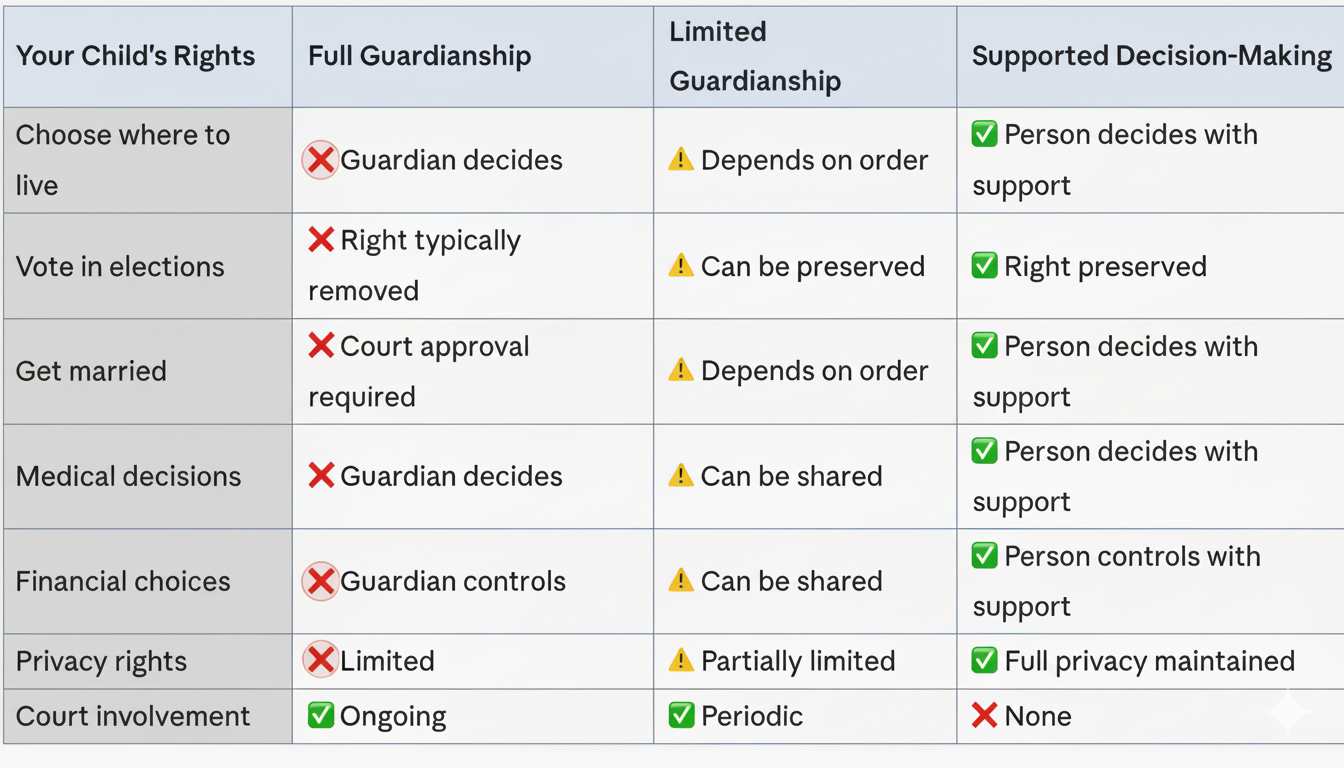
Quick Comparison: Rights and Reality
Your Family’s Transition Timeline
Junior Year (Age 16-17):
- Start conversations about future goals and support needs
- Integrate planning into IEP meetings – transition planning is required by federal law starting at age 14
- Connect with local resources (see Hampton Roads contacts below)
- Begin identifying potential supporters from family, friends, or trusted professionals
Senior Year (Age 17-18):
- Draft SDM agreement with clear roles and boundaries (templates available from dLCV and The Arc)
- Create backup plans for emergencies or complex situations
- Establish banking and healthcare relationships with SDM documentation
- Evaluate whether limited guardianship might be needed for specific areas only
Warning Signs SDM May Not Be Sufficient:
- Repeated dangerous decisions despite consistent, informed support
- Inability to understand basic consequences even with extensive assistance and accommodations
- High risk of financial or physical exploitation without legal protective authority
- Need for immediate legal authority in crisis situations (medical emergencies, financial fraud)
- Complex estate or financial management requiring fiduciary responsibility
Hampton Roads Resources That Make the Difference
The Arc of Southeastern Virginia
- Monthly SDM workshops in Norfolk and Virginia Beach
- One-on-one family consultations
- Peer support groups for parents navigating the transition
- Website: www.arcseva.org
disAbility Law Center of Virginia (dLCV)
- Free SDM agreement templates and legal guidance
- Consultation services for families
- Website: www.dlcv.org
School District Transition Coordinators
- Virginia Beach: Integrate SDM planning into IEP meetings
- Norfolk: Specialized transition programs for students with disabilities
- Chesapeake: Community partnerships for post-graduation support
- Contact your child’s school special education department
Community Direct Services
- Free consultations to assess your family’s needs
- Connections to legal aid for SDM agreement drafting
- Ongoing support and advocacy services
- Phone: (757) 461-8007
The Bottom Line: Dignity vs. Control
The choice between guardianship and SDM often comes down to your family’s core values and your child’s actual support needs:
Consider Limited or Full Guardianship if:
Your child genuinely cannot make or communicate informed decisions even with appropriate support, or needs protective legal authority that SDM cannot provide.
Choose SDM if:
Your child can make informed decisions with help, and preserving their autonomy and dignity is a priority.
Remember: SDM can be tried first and supplemented later with limited guardianship for specific areas if needed.
But once full guardianship is granted, petitioning the court to restore rights requires another legal proceeding, expense, and demonstration that circumstances have changed.
Take Action Before Time Runs Out
Virginia’s trend toward recognizing SDM reflects a national movement toward dignity and self-determination for people with disabilities.
But family planning and early education remain critical.
Don’t let urgency force you into a permanent decision you’ll regret.
Ready to explore your options? Schedule a free 15-minute consultation with Community Direct Services to create your family’s personalized transition timeline – before the pressure of senior year hits.
Call (757) 461-8007 or visit our contact page
Download our free “SDM vs. Guardianship Decision Guide” – a step-by-step worksheet to help your family evaluate what’s right for your situation.
References and Source Links
Virginia Laws and Regulations:
- Virginia Code § 64.2, Chapter 20 – Guardianship and Conservatorship Laws
- Virginia Code § 37.2-314.3 – Supported Decision-Making Agreements
- Virginia Code § 64.2-2007 – Alternatives to Guardianship
State Agency Resources:
- Virginia Department of Behavioral Health and Developmental Services – Supported Decision-Making
- Virginia Department for Aging and Rehabilitative Services – Guardianship Information
Advocacy Organizations:
- disAbility Law Center of Virginia (dLCV) – SDM Resources
- The Arc of Virginia – Decision-Making Supports
- The Arc of Southeastern Virginia
- National Resource Center for Supported Decision-Making
Legal Resources: